Thursday, January 13, 2011

Saint-Julien-lès-Metz

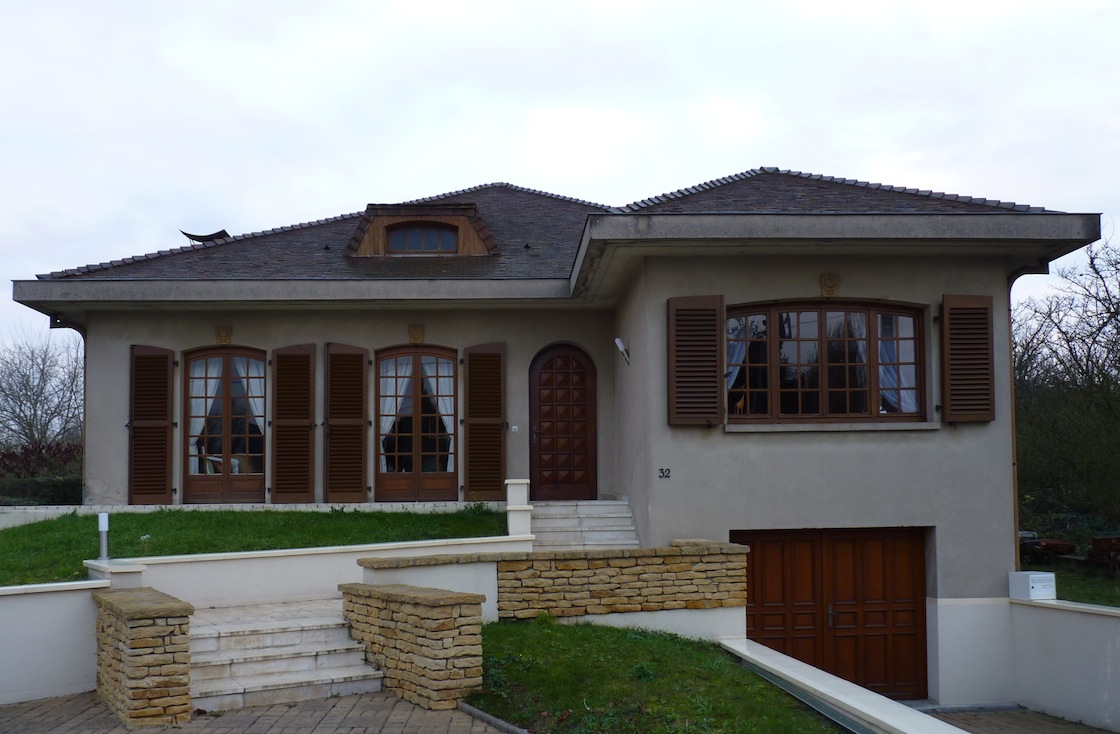
The archives of the Department of the Moselle surmount the village of Saint-Julien-lès-Metz, just north of Metz, across the river Seille. Below the archives, to the west, sits one of the several major forts surrounding Metz. To the north and east lie rolling fields. And downhill to the south of the archives lies the village itself. After our visit to the archives for the exhibition on the expulsions of World War II, Susie and I walked the back to our hotel, a route of about 3.5 kilometers. Saint-Julien-lès-Metz is a well-heeled village, with nice villas and condominiums. Here are a couple of the villas that we passed during our walk. They're not spectacular, just well-to-do, well-kept, and very French, to my eye.Toward the top of the village, the visitor finds numerous apartment buildings, which I figure are condominiums. These are modern and look up-scale. Here's an example. Almost all the dwellings of modern Saint-Julien probably date from the 2oth Century. A painting in the Metz art museum shows a view, dated 1833, of Metz from Saint Julien. The city's surrounded by fields instead of houses. Here's a view, roughly from the same direction but not as high up, taken during our visit in November of 2010. You can still see the cathedral, but buildings now completely fill in the landscape.

Faces of Metz

Esplanade, Metz

Wednesday, January 12, 2011

The Place de la République

All during our stay in Metz last year, the Place de la République was a mess, torn up and muddy, with its construction spilling over into the adjacent boulevard and turning the city's largest bus hub into a crazy quilt of displaced bus stops. On our return for Thanksgiving, all the work was finished and the square's holiday activities were in full swing. We arrived on a Sunday, and the square had just been officially reopened on Saturday afternoon.

The most obvious feature was a temporary one: an enormous Ferris wheel that was visible for miles around. And at the base of the Ferris wheel stood seasonal attractions, including a branch of the Metz Christmas fair, which had been sidelined last year, and an ice-skating rink.

The various venues of the Christmas fair--the train station, the Place St. Louis, the Place St. Jacques, the Place de la Republique--have different decorative themes. At la gare, the booths look like railroad cars. At the Place St. Jaques, the booths have fanciful roofs, over which hangs a net of shimmering stars. At the Place de la Rep', the booths represent, I think, chalets.
Throngs of people, mostly young, flocked to the ice-skating rink. Individuals had varying levels of evident skill, and tumbles were common. Everyone, with exception of perhaps a small crying child, seemed to be having fun.
Other than the fountain on the Esplanade, the ice-skating rink represented the area's only water feature, and a frozen one at that. Come summer, the Place de la Rep' should be flowing with water features. There's even a "beach" built on a wooden deck.
The Grande Roue, whose loading structure also reflected the chalet style, towered above the area. This massive machine, on which Susie and I rode, of course, turns out to be from Germany; it was made by the Great Wheel Corporation of Munich.

From the top of the Grande Roue we could see far and wide. We easily spotted Metz's new permanent landmark, the Centre Pompidou-Metz. You can also see the train station's water tower at the left.
Closer to home, we could find the apartment we stayed in while living in Metz during the winter and spring. Our building was the one with the gray roof in the center of the photograph.
After our revolutions on the Grande Roue, we looked back at it and the Place de la République from the Esplanade. Even when the wheel and rink are gone, the Messins will have a great public space to enjoy.

Tuesday, January 11, 2011

The Liberation of Metz, November, 1944

November 20, 2010, the day Susie and I boarded the airplane to return to Metz, coincidentally marked the 66th anniversary of the city's liberation by American forces. The liberation of Metz was a hellish task, as the city and its surrounding were among the most heavily fortified in Europe. The tourist office, on the north side of the square bordered by both the cathedral and the hotel de ville, displayed a banner commemorating the liberation. On the south side, opposite the banner, a plaque on the base of a statue marks the place where General Walker of the U.S. Army handed over to the French authorities the city liberated by his troops. The mayor's office placed a ceremonial bouquet under the plaque. Many more bouquets surrounded the monument honoring the U.S. Army's 95th Infantry Division, the Iron Men of Metz. Among the tributes, just below "Metz," was a red-white-and-blue floral arrangement from the Association Lorraine-Etats Unis.

Monday, January 10, 2011

The Moselle in World War II

"De gré ou de force, l'expulsion des Mosellans 1940-1945" ("By will or by force, the expulsion of the people of the Mosell") is the current exhibition of the Departmental Archives of the Moselle. It follows logically from the Archives' previous exhibition, which covered the evacuation of people from region to other places in France that were less likely to be close to battles. The Archives did remarkable work for both exhibitions. In the pre-war evacuation, the French government moved inhabitants of the Moselle region, especially those closest to the German border, to places of relative safety in other parts of France. As documented in the Archives' prior exhibition, "Un exil interieure: L'evacauation des Mosellans," about 300,000 people from the Moselle moved in September 1939 and May, 1940 to regions closer to the Atlantic. After the French capitulation in September, 1940, most of these people returned to their homes in the Moselle. The current exhibition documents the brutal wartime expulsions, part of the Nazi plan to "Germanify" the Moselle. This region, considered by the Nazis to be not occupied France but rather an integral part of Germany, saw 100,000 inhabitants expelled as "undesirables." Some left willingly, others only when forced. For the most part, they were French speakers who didn't fit into the victors' vision of a German Moselle. The Nazi authorities limited the expulsed to 2,000 Francs and 110 pounds of baggage; everything else--houses, furniture, clothes, shops, factories, dishes, toys, and tools--had to be left behind. German posters proclaimed the new cultural order. "It's a privilege and an honor to be German," declared Metz's new ruler. All that was French was to be swept away. Streets were renamed for prominent Nazis. The expulsed ended up, for the most part, in the Midi--south central France. Many lived in poverty. Local inhabitants of the Midi provided shelter and support, and the Vichy government trumpeted its support in its own posters. This one shows well-fed children at the winter aid cantine of the Marshall (i.e., Maréchal Pétain.) In the cities of the Midi, the expulsed tried to keep their culture and traditions alive. These advertisements in the Periguex newspaper, for a restaurant, a tailor, and a tavern, suggest to me that these cities must have had a "little Alsace and Lorraine," something like little Italy in New York City. With the Allies' victory, the expulsed began to return home. Despite German assurances when they left the Moselle that their property would be protected, they soon found that everything had been systematically looted. This letter, to a man in exile in Casablanca, informs him that his tire-repair shop is now unoccupied but that it had been emptied of all of its contents in the first months of the German occupation. In the immediate post-war, life was hard in France and especially in Alsace-Lorraine, which saw the worst of the fighting. The expulsed, who had lost almost everything when they left and found little when they returned, were among the worst off. They organized to claim their rights. Here's a poster calling for the expulsed and refugies to hold a big demonstration in Metz. Contemporary Metz no longer has the street names imposed by the Nazis, but the story of the expulsed is still within the city's living memory. The exhibition "De gré ou de force, l'expulsion des Mosellans 1940-1945" runs through 31 May, 2011.
Sunday, January 9, 2011

What's new, Metz?

The biggest change in Metz since we left in June is that the refurbishment of the Place de la République, the city's largest public square, is complete. Indeed, the dedication ceremony took place the day before we arrived. The Pompidou Center-Metz continues to attract crowds; we met a group from Nîmes who had come up for a couple of days, with the new museum as the anchor site for their trip. The holiday lights on some of the streets have been updated, and the Christmas markets have expanded into the Place de la République itself, after having been pushed to the sidelines by the renovation. There were new exhibits at both the city and departmental archives. The cathedral's tower is still being renovated, with years to go, I think. The Saint Martin church near our apartment is now being renovated, too. Not surprisingly because we'd only been away since June, most of Metz seemed to be pretty much as we'd left it. Because the holiday decorations are up and the Christmas market had started, I had the feeling of completing a cycle of seasons. These were nearly the sights that greeted Susie and me when we arrived for the first time in December of 2009. The sellers of patisseries displayed seasonal treats, like large chocolate figures of Saint Nicolas of Metz. They also displayed the usual, electrifying choice of cakes, pastries, cookies and other desserts, which seemed as vivid in real life as in my envious recollections back in El Paso. Georgia Tech Lorraine continues to thrive. We missed the 20th-anniversary celebration, which brought in dignitaries from far and wide. We did have a chance to see my colleagues from the staff and to have dinner with some of my faculty colleagues. The students I'd taught had left for Atlanta, though. I still occasionally hear from some of them via e-mail, I'm glad to say.

A Return to Metz

For a week, over Thanksgiving, Susie and I returned to Metz to see friends and to get a refresher of Lorraine cuisine. Over the next several posts, I'll explain what's new in Metz, tour an exposition on the Nazi expulsions of residents of the Moselle in World War II, note the commemoration of Metz's liberation 66 years ago, visit the Place de la Republique, tour St Julien-les-Metz, share a few details that caught my eye, and wrap up with some memories of the three communities in Metz with whom Susie and I are entwined.