Morette, Savoie

Eglise Saint-Maximin à Mondelange (Moselle)
9 years ago
 At the pass itself, you find views of the rugged formations of the Aravis range.
 As the snow fields melt, they feed streams that tumble from the mountain in long waterfalls.
 The museum's building, the chateau d’Arenthon, contains three floors of galleries, plus a gift shop and a salon de thé/library. After seeing the exposition with Susie, I skimmed a great book on Shepard Fairey while sipping a soft drink. Sculpture gardens surround the chateau.
 The current exposition, "Collection 3," shows works from the private collection of Claudine et Jean-Marc Salomon, primarily figurative drawings and paintings. The exposition displays its most abstract works in the top-floor gallery.
 The exposition contains many memorable works, all by artists born after 1960. One fun piece was Shepard Fairey's ersatz record label for "The Last of the Rebel Waltzers," part of an extensive series of related works. This particular work includes several long-running Fairey motifs, including "OBEY" and the abstract Andre-the-Giant-in-a-star logo. You can buy (at exceptionally reasonably prices) original works directly from Shepard Fairey at his Web site, obeygiant.com.
 This large untitled work by Olivier Masmonteil struck me as a clever commentary on the relationship between landcape and abstract painting.
 The building itself is interesting, combining Gothic architecture and contemporary art. Here's a view of across the entry toward a circular stairwell visible through a window.


 Susie's and my last longish hike in the Savoie was on the west side of the Montagne de Sullens, which rises, southeast of Thônes, to just over 6,000 feet. Starting out below the Col du Plan de Bois, the trail wound its way around the northwest slope of the Montagne de Sullens. We could see across the valley clear to the Col de la Croix Fry, where we'd started a hike a few days earlier.
 And in the valley below was the village of Manigod.
 To our east rose the Aravis mountain range, with the pyramidal Pointe de Merdassier and the jagged Etale. There's a trail up the ridge of the Merdassier, but taking it involves climbing something like 2650 feet straight up.
 The slopes of the Montagne de Sullens were dotted with chalets for working farms. This 0ne had laundry hanging out to dry. Note the massive protection against avalanches and falling rocks.
 Our path wound south, with the Montagne de Sullens on our right, and the pass of the Plan du Tour ahead, as our goal.
 The Montagne de Sullens, at least on its east face, is awfully barren. It reminds me of mountains in Scotland, perhaps not coincidentally because in both places sheep or goats have probably eaten most of the vegetation.
 While the goats continued to munch, off to our right, we reached the Plan du Tour, having climbed about 1,400 feet along the way. At the pass, we enjoyed the great vista to the south before retracing our steps downhill to the car.

 Interesting waterfalls, including this spectacular twisting torrent, drop from the top of the cliffs toward the Fier.
 In World War II, the Plateau de Glières served as the setting for the Battle of Glières, between the Free French fighters, called the Maquis, and the combined forces of the Vichy regime and the Third Reich. By the winter of 1943-1944 the Maquis had conducted attacks on Vichy forces and was preparing to support the Allied invasion of France, then expected to take place in the spring of 1944. The British forces chose the Plateau de Glières as the best site at which to parachute loads of weapons and other supplies for the Maquis.
 Lt. Morel had first been buried on the top of the snow-covered plateau, during the fighting. His remains were later moved to the Glières Nécropole and are remembered with one of the cemetery's bronze markers.
 The site of the memorial includes, in addition to the cemetery, three buildings that comprise the Musée départemental de la Résistance and the Mémorial départemental de la Déportation. The Resistance Museum is housed in a chalet, moved to the site, of the kind in which the Maquis sought shelter.
 These museums educate visitors about the history of the resistance in Savoie and about the Nazi's deportation and murder of millions. The exhibits are well done, fascinating, and moving.
 I'm glad to note that, while we were there, groups of school children toured the site and the museums.
 In death, the resistance fighters buried at the Glières cemetery inspired other resistance forces in France, and especially in the Savoie, which was the only region in France to be liberated by resistance forces. The city of Annecy was the last German stronghold in the region to fall. The operations of the Maquis were daring and resourceful, capturing hundreds of Nazi soldiers and quickly obtaining the commander's surrender. The resistance forces drove their trucks into the liberated city.
 Today, the memorials and museums serve to keep alive the history and memory of the resistance fighters of the Plateau de Glières. And the Glières cliffs, once a defense against Nazi attacks, now have a much happier role as an aerial playground for parapenters.

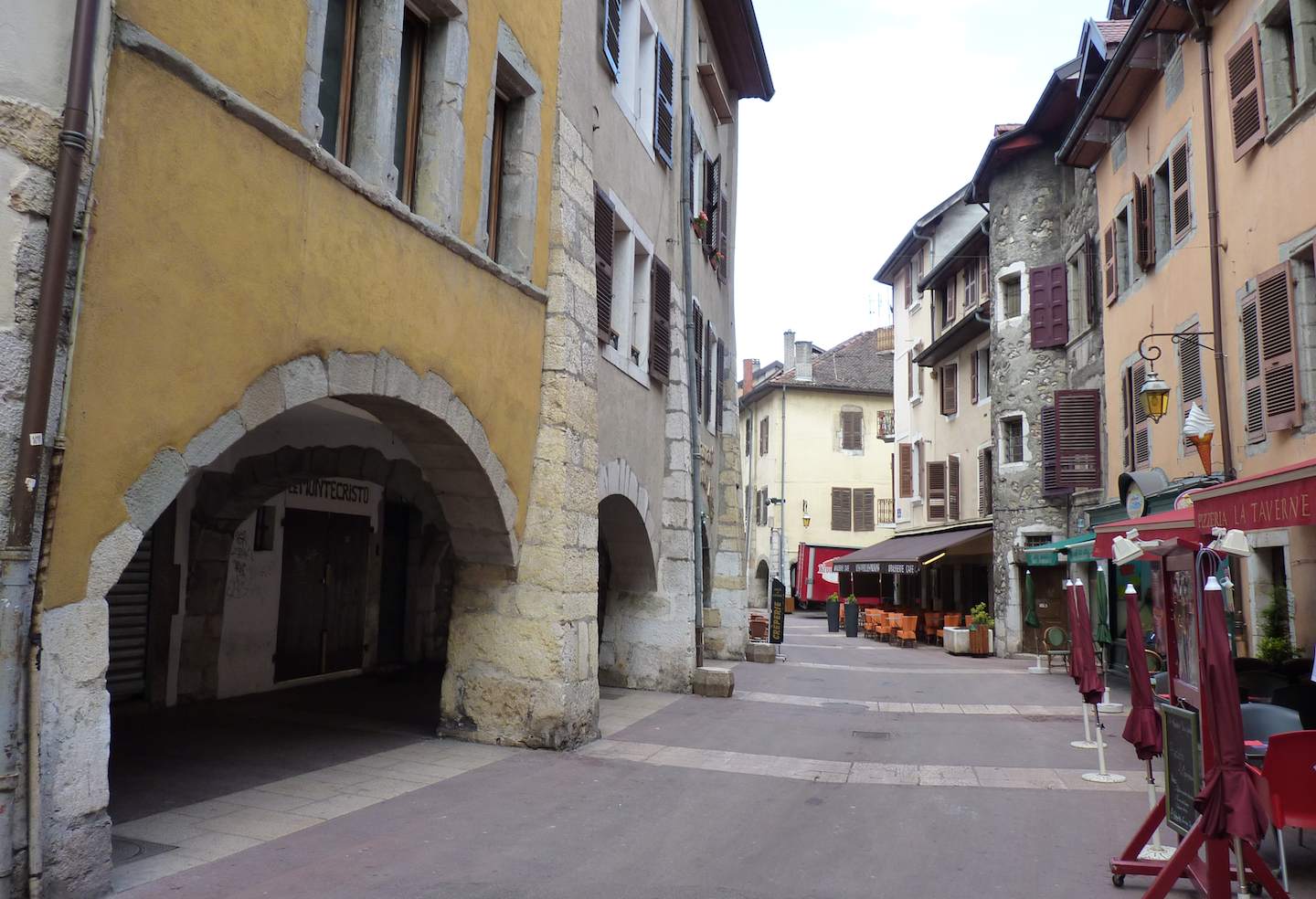
 Some of the medieval streets, in concentric circles around the base of the chateau, have massive arcades.
 Water flows through medieval Annecy in multiple channels of the Thiou Canal, so this area is called "Little Venice."
 The buildings along the canal are picturesque, and perhaps self-consciously so.
 The various channels of the canal are so pervasive and complex that one of them actually flows right under the city's cathedral.
 As a resort city, Annecy has all the attractions a visitor could want, including artisanal ice-cream shops. If you ever wanted to know what a smurf tastes like, here's your chance. One of these flavors is "Schtroumpf," which is what smurfs are called in France.
 Where the canal meets the Lac d'Annecy, boats lie ready to give rides to visitors.
 La Belle Fleurie, the farm a 100 meters or so from our gite outside Thônes, produces tomme fermiere. Tomme is one of the two main cheeses of Savoie, the other being reblochon--a mural on the highway to Thones depicts the city as the capital of reblochon. Fermiere means that it's an artisanal, farm-produced cheese. We visited La Belle Fleurie twice, in the morning and again in the late afternoon, to tour the cheese-making facility and to see the cows being milked.
 The owners of La Belle Fleurie, Arlette and Henri Clavel, were kind enough to show us their farm. M. Clavel milks the cows twice a day, every day, at 5:30 a.m. and 5:30 p.m. Every cow has a name, such as Dahlia. The cows come to the stable from the fields.
 The cows take their places in the stable. M. Clavel said that cows have highly hierarchical relationships, with a chief cow. The cows all have bells because, Mme. Clavel explained, she and her husband like the sound and, more practically, the bells make it possible to know where the cows are, to hear if they're agitated, and to find a lost cow.
 Some of the bells are simple. Others are ornate. This one has symbols of the Savoie, including the Savoie coat of arms, a pine tree, and a chalet.
 While you're being milked, why not enjoy the salt lick?
 The farm uses organic methods, and its cheese is certified as "biologique." M. Clavel even studied homeopathy so he could treat the cows. The cows eat meadow hay from nearby fields, all grown naturally, unseeded, and without pesticides. During the summer, each cow eats about 2.5 kilos of hay a day, in addition to what they eat in the pastures. In the winter, when the cows have to stay inside, they eat hay that's been stored for the season, about 120 tons of it. M. Clavel showed us some of the meadow hay--it's almost something that you'd buy in a fancy store for use in sachets. The field next to our gite is one of the fields that M. Clavel cuts for hay, and it's brimming with flowers.
 After being milked, the cows get a helping of organic grain as a treat, and then they head back down to the pastures.
 Mme. Clavel uses the raw milk from the cows to make the tomme fermiere. The farm's particular niche is an organic, soft tomme, unusual in the market.
  The milk, with a curdling agent, is heated in a stainless steel cauldron. The curds are mixed, then pressed into molds and left to drain. The farm produces about 15 cheeses from each milking, so this is truly the opposite of industrial farming.
 For M. and Mme. Clavel, this is clearly a labor of love. They care deeply about their cow, about organic farming, and about traditional methods of making cheese. Eight years ago they left salaried city jobs to start their farm. Today, they sell all the cheese they make, and could probably sell much more if they had it. M. Clavel does not wear a watch, nor does he have a cell phone. They work every day, day and night. It's only in the last few years that they've taken any vacation at all, and that's been limited to about four days a year. Indeed, it's hard for them to relax on vacation, because even though while they're gone the farm is in the hands of an experienced farmer/cheese-maker, their minds are always on their cows.